
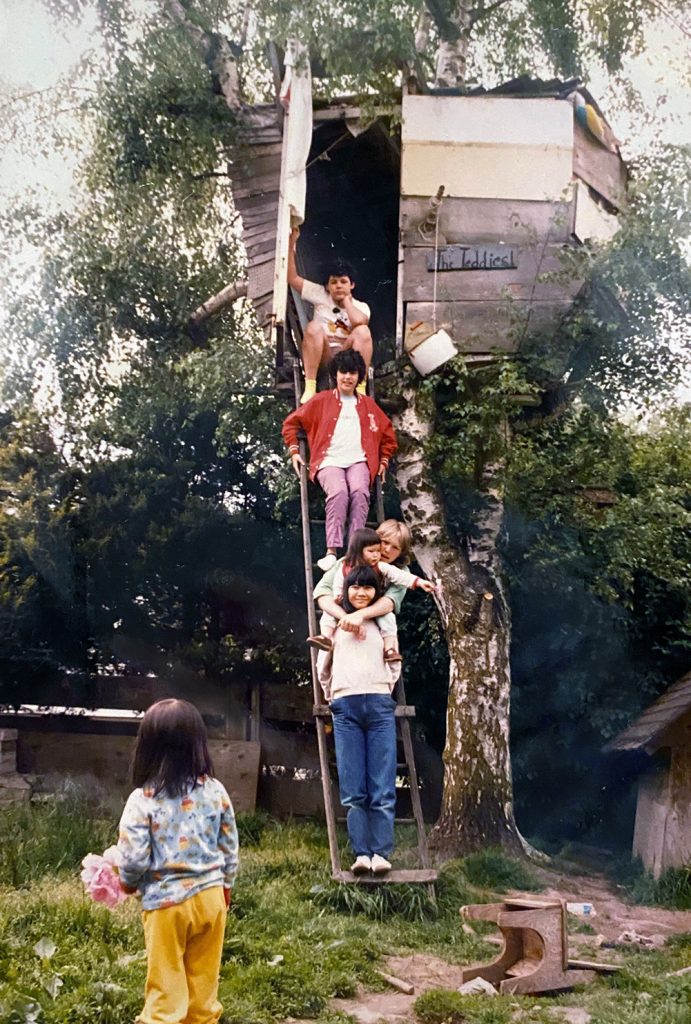
“Third Culture” was first coined in the 1950s by the sociologist Ruth Hill Useem, who was referring to the learning process of how to relate to another culture; eventually they began to refer to children who accompany their parents into a new country with a different culture as “Third Culture Kids,” aka TCK.
Third Culture Kid is relatively a new terminology and has been adapted to modern times as someone who grows up in a culture that is different from their parent’s. This includes (but not limited to,) the children of families who immigrate to a new country, international students or those who live an expatriate life. Eventually, answering ‘where are you from?’ is not as simple as one would think.
My parents are Chinese – born and raised. They had to immigrate to Canada when they were pregnant with me due to the one child law in China, and I was their second child. I was born and raised in Canada where it wasn’t as diverse as it is now. I was the only Asian in my kindergarten class.
Later on I moved to Vietnam and have called Ho Chi Minh City my home for nearly 10 years, so when people ask me where I am from… well it takes a while to answer. If I just say Canada then they often ask, “where is your family from?” And if they are less polite, “where are you really from?” In fact, it the first few lines of Vietnamese I learned was: “hello,” “thank you,” “sorry” (because I am Canadian after all,) and “I am from Canada and my parents are from China.” Sometimes it was followed by, “sorry, I don’t speak Vietnamese,” if the person try to inquire further.
We as Third Culture Kids have our own unique set of life skills and problems we encounter as we grow up. Of course, we are all different and our experiences will vary, but here are some commonalities:
Challenges for Third Culture Kids:
- Grief of losing friends and family
- Exposure to poverty and corruption
- Identity crisis
- Starting from scratch each time you move
- Trouble relating to parents cultural background
- A painful awareness of reality
- Answering the question: “where is home?”
- Ignorance of home culture
- Ignorance of host culture
- Difficulties adjusting to adult life
- Inability to relate to people back home
Benefits of being a Third Culture Kids:
- Develop friendships quickly
- Have a multicultural view of the world
- More sensitive to other cultures
- Better understanding of different ways of life
- Self-confidence
- Cross-cultural awareness and competence
- Cross-cultural intelligence
- More mature then their peers from home country
- Flexible and adaptable
- Independent (more then others their age)
- Multi-lingual
– Pollock & Van Reken
A third culture kid (TCK) is considered “a person who has spent a significant part of his or her developmental years outside the parents’ culture. The TCK builds relationships to all of the cultures, while not having full ownership in any. Although elements from each culture are assimilated into the TCK’s life experience, the sense of belonging is in relationship to others of similar experience.”
 English